
A lifestyle trend that was much in vogue in the 2010s (before the pandemic era scarcity panic turned us all into preppers and packrats) was “minimalism”—the art of living with less—and it seems to be making a comeback.
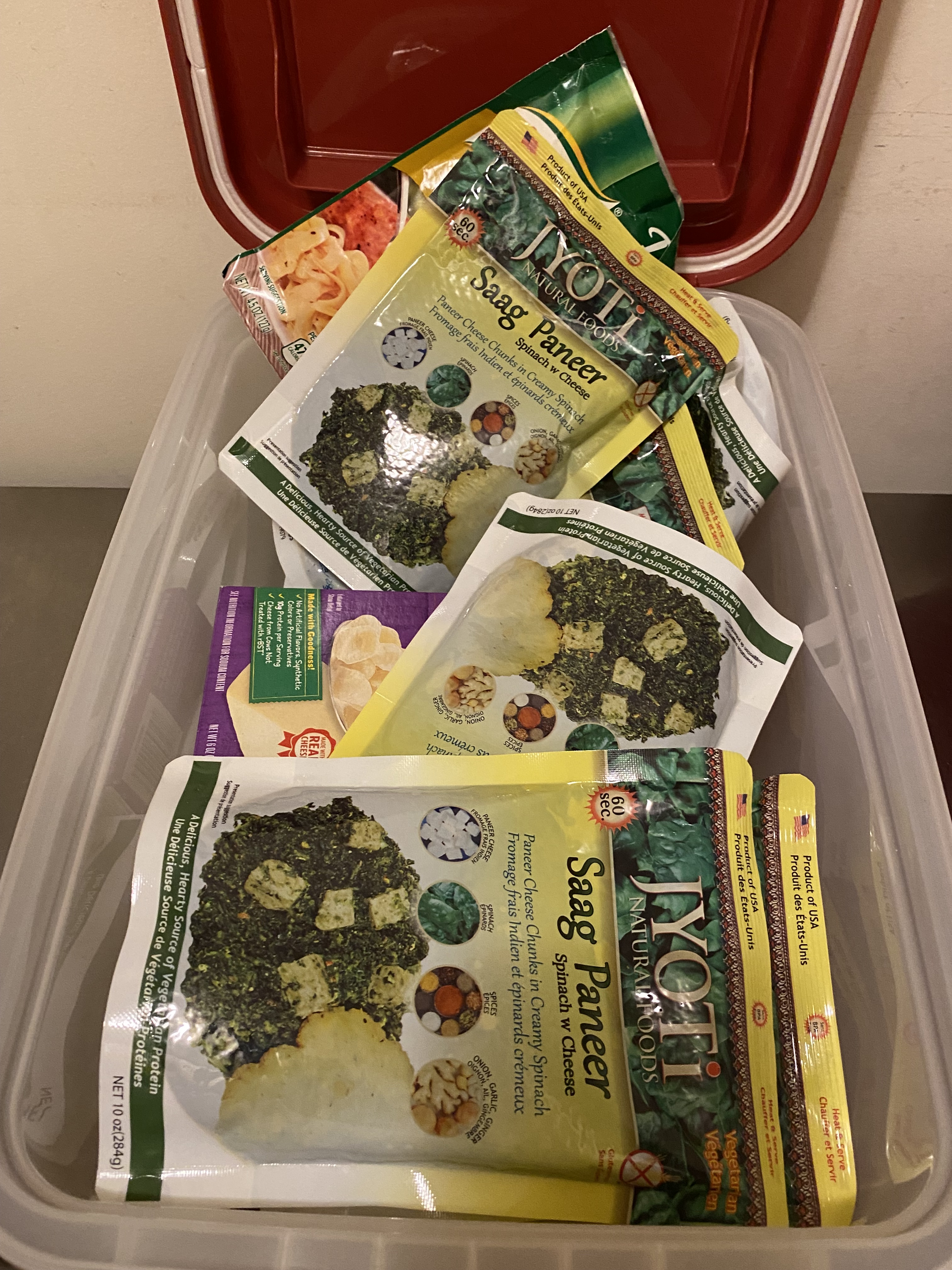



Lots of us got in the habit of overstocking stuff during the pandemic. Three years later, the water gets used and regularly restocked, but the vacuum-packed saag paneer and canned goods are another story! It’s probably getting close to the “use by” date on some of these!
I don’t usually fall for fads, but… this one was… tempting. Who among us doesn’t have “too much stuff” and a vague desire to get rid of some of it? Haven’t we all, at some point, bought things impulsively because a shiny new object stimulated the pleasure center in our brain? Yes. Yes, we have. And we’ve held on to them because we’ve already paid for them, and we are suffering from the “sunk cost” fallacy that philosophers have warned us about.
Excessive buying is like overeating; we do it because our brains aren’t great at telling us to stop; this skill probably had no evolutionary value in the constant struggle for resources that was the reality for 99% of our existence as a species. (For many people it still is, but that’s not relevant to why others of us buy and hoard so much). And here we are, ostensibly conscious and “civilized” and still warring with that part of ourselves whose primal instincts made us accumulate all these useless “resources.”
That internal war is why it’s so alluring to think maybe fewer possessions will simplify our routines, save time and money, and make space in our life for more fulfilling pursuits. I’ve been wanting to “pare down” and “declutter” forever… long before the influencers were abuzz about it.
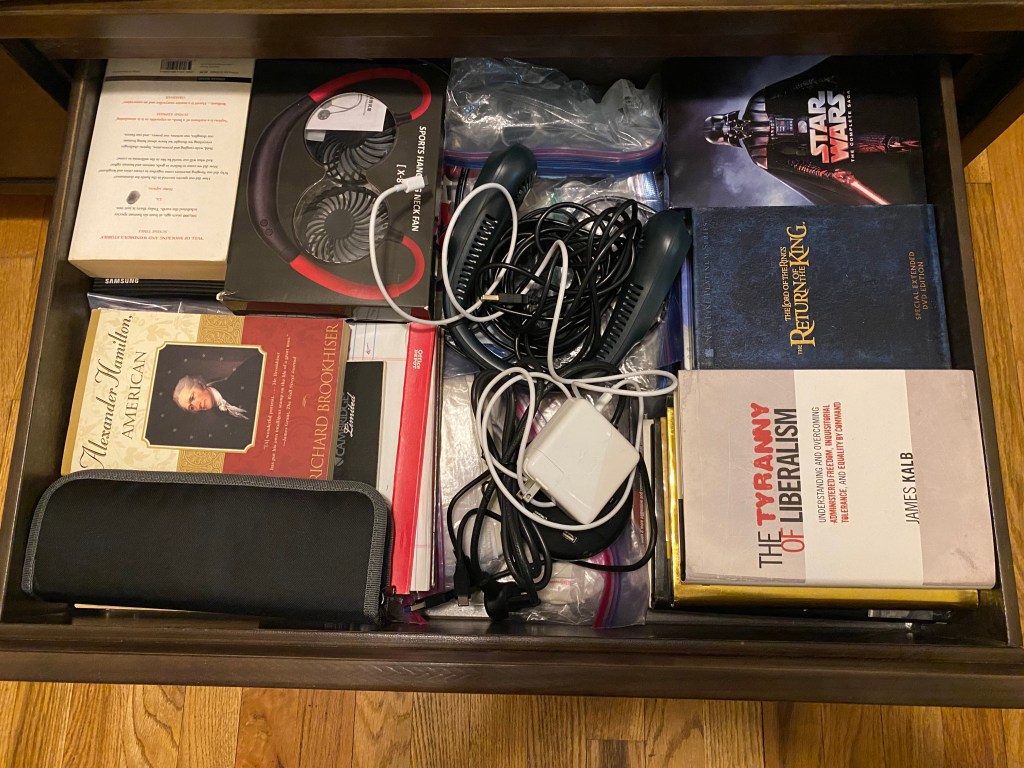


Around 2018, I decided it was time. Millions of people were supposedly doing it. There were whole “communities” around this. I wasn’t about to join a “movement” or anything, but I felt encouraged.
I turned to the internet looking for advice and inspiration (always a wise move, am I right?).
The first thing that struck me was how many minimalism gurus told me to BUY NEW THINGS. That’s right. Apparently, you need new stuff in order to “minimize” your stuff! You throw out all your clothing, furniture, etc., and replace them with newer—more expensive—items, so you can feel luxurious in your new asceticism. Well, that’s not exactly how they put it. What they say is: you need a few “select” items of “higher quality” that will last longer and won’t need replacing often. Also, everything will look and feel more polished and elegant. (And all this with a side serving of lectures on being “less materialistic”!)
The second thing that struck me was how elaborate the procedures were for owning less stuff. Charts. Inventories. Meditation and journaling about gadgets and furnishings and what each piece means to you. Tracking which clothes you wear and how often. When these guys weren’t telling you to fork out a small fortune to feel extravagantly self-denying, they were telling you to devote all your time and thoughts to managing your things and contemplating what you like, what you need, what you should discard, and the psychology of it all. There were testimonials about personal “journeys” (lots of them).
An inordinate portion of the advice seemed to be about wardrobes. Apparently, this is the area of material possession that we’re most likely to feel overburdened with and want to thin out. There is the “333 challenge”; the “capsule wardrobe”; the “100-piece wardrobe”– among a multitude of others. Many of these have grown into (at least one) major book, seminars, courses and prompts you can subscribe to for a price—and even merchandise, ironically enough!
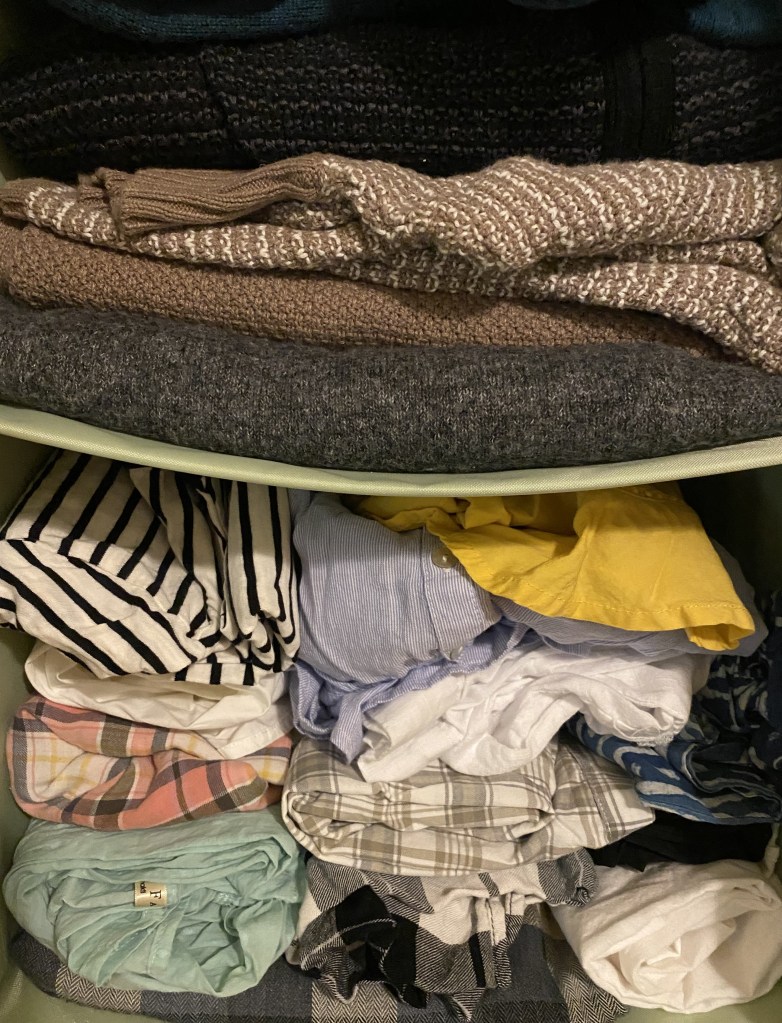
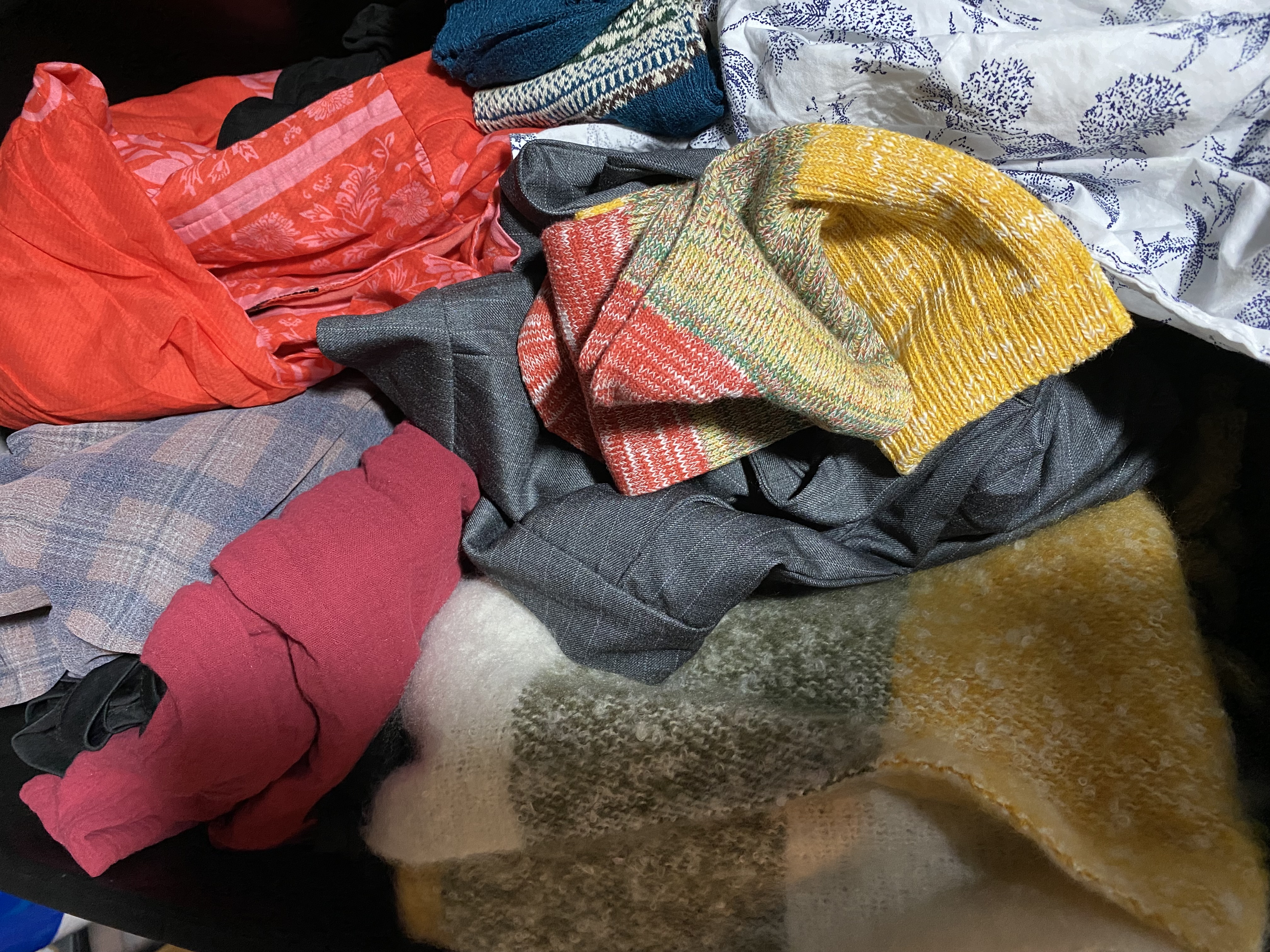

The “333 challenge” was created by Courtney Carver, author of the book “Soulful Simplicity” and the “Be More With Less” blog. Many fashion and lifestyle writers have developed their own variations on it. The basic idea is:
- Select 33 pieces.
- For 3 months, wear these exclusively.
- After 3 months, update the wardrobe for the next 3 months, replace some items, keeping others—as you like—but keep the total at or under 33.
- Repeat every 3 months.
Opinions differ, but the 33 usually includes clothes, shoes, handbags, and accessories, but excludes underwear, socks, work or school uniforms, gym clothes, swimsuits, and loungewear. In some versions, instead of chucking everything that didn’t make the selection, you pack it away somewhere hard to reach and you go “shopping” in your storage for the next time you update. Others say you should select 33 pieces for each 3-month season for a whole year (132 items total) and discard/donate everything else permanently. Going forward, for each 3-month period, you’ll take out what you wore in the same season the prior year and see what you still want. You can buy new things, but you must let go of something from the existing repertoire to keep the total number capped at 33 per cycle. Some variants suggest adjusting the number to suit your personal needs.
Ok, I don’t know about you, but I’m not willing to put this much effort into achieving “simplicity”!
The capsule wardrobe concept, I’ve learned, began in the 1940s and has been revived several times, including by English clothier Susie Faux in the 1970s, American designer Donna Karan in the 1980s, and the internet minimalists since the 2010s. In this system, you pick a signature color scheme around a “neutral” like black or brown (subdued tones like gray or beige are most popular) and pick a few items that all go together, topped off with a couple of “statement” pieces to add the occasional bit of panache. It’s suggested that you only keep pieces that are well-made, of high-quality materials, and in classic designs unlikely to go in and out of style. You can keep your look updated by swapping out one or two pieces per year (or season). If you don’t have an adequate number of such quality items, they tell you to “invest” in some great pieces now and save on not having to replace things often. (They don’t say what to do if you can’t/don’t want to spend big bucks upfront for the sake of “having less” or if you’re too busy to have your dry cleaning done twice every week so you don’t run out of clean clothes for work….)
The key feature of the capsule wardrobe is that everything goes together, so you don’t spend much time coordinating outfits—theoretically, anyway (because, let’s be honest, no matter how sartorially nonchalant we might be, there ARE times when we can’t “just throw things together” even if our wardrobe is literally 50 shades of gray—or is it 33 shades? No, wait, capsules are even smaller… oh, I give up.)

The 100-piece wardrobe is self-explanatory. Approaches vary as to how you select what to keep. Some advisers tell you to separate all your clothes into piles divided by category and season, then pick your top favorite from each pile and put them in a “to keep” pile, then add your next favorite ones, and so on, until you’ve reached 100 items total. Others tell you to buy a few new things you “need” to make sure everything you own is loved and utilized.
Marie Kondo, the Japanese “organizing consultant” and international bestselling author, recommends a radical downsizing of everything you own—not just clothes—though she’s not a “minimalist” per se. Her system entails taking all your belongings, one category at a time, piling them up on a bed and going through them ruthlessly, keeping only that which “sparks joy” and tossing everything else. She also has intricate methods for organizing the stuff you end up keeping.
Her system (which, I hear, can take weeks or months to fully accomplish) is much too convoluted for my taste. But I do love its one salient feature: the much maligned and mocked “sparks joy” concept. Joy doesn’t mean giddiness. In this context, it means comfort, satisfaction, and a recognition that an object is useful or enjoyable or that it has sentimental value. Crucially, “sparks joy” indicates that this recognition of an object’s value (to you) is immediate and instinctive. If you need to think about whether it is useful or enjoyable or sentimental, then it doesn’t pass the “sparks joy” test, even if there’s nothing wrong with it. It shifts the burden of persuasion from favoring retention to favoring elimination.
It’s a rather brilliant outlook on possession, if you think about it. It says you should intentionally select what stays in your life and let everything else go without bellyaching over it. Although Kondo undermines her own point by telling you to allocate heaps of time and mental energy toward getting rid of things, the beautiful truth is, I don’t have to accept those parts of her advice! I can take the underlying insight and leave the aspects that, for me… don’t spark joy!
Then there’s the “subtraction project” (developed by podcaster and blogger Cass McCrory, whose work has appeared on the social journalism platform Medium.com). McCrory says she’s not a minimalist, just someone trying to live with less. Her approach is more sensible and less fussy than most others. Basically, you just set aside some time each day (or week) to go through one area of your home—it could be a whole room or just one closet or a set of drawers, or even one drawer, whatever you have time for—and look for things that are non-useful or unsightly or in disrepair. Get rid of those. Start with the easy things, the obvious “junk” you don’t have to think about. You’ll do another round later, and you’ll have to consider more carefully at that time, but it will be less daunting because you’ll already have a cleaner, somewhat less cluttered area than before.
Alas, even this charmingly no-nonsense idea soon became cumbersome, as its purveyor kept expanding the “project” to the point where it seemed to be recommended as something of an on-going obsession rather than as a finite plan to declutter your home and move on with life. She also offered a paid subscription (available at various price levels) to get regular tips on what to throw out next. (Well, I’m not really looking to take up this “throwing stuff out” thing as a lifelong hobby… but, uh… you do you!)
But seriously, I do like that her focus is not on specific numerical goals or making big changes all at once. It’s about eliminating the excess gradually, at a comfortable pace.
Most of these “methodologies” though, I think ultimately defeat the purpose of minimizing, which is to free ourselves from the trap that “stuff” can become. Too much stuff taking up space and time (time spent looking for that ONE thing you need in an overstuffed cabinet or time spent coordinating an outfit from too many choices). But, if you’re just swapping this kind of time-suck with the equally giant time-suck of the “minimalist” or “decluttering” program you’ve set up for yourself, constantly planning, sorting, cataloging, organizing, experimenting, meditating… then, what is even the point?
As someone (apologies for forgetting who) once said, “if organizing your stuff really worked, wouldn’t you be done by now?”

I came across a “wardrobe-minimalist” blogger who said, with no hint of irony, that she’d been “doing this minimalism thing for years” and still found it hard. Just to clarify, she didn’t mean that she’s been living with less for years. She meant that she’s been downsizing and fretting about how much clothing she has… for YEARS. And this was in a blog post promising “effective” tips for minimizing!
I don’t mean to shame anyone. But this seems unhealthy. I don’t know if obsessing about how to get rid of things—for years and years—counts as “minimalist” by any reasonable definition. But, more importantly, if it proves this near impossible, wouldn’t it be better just to embrace the clutter and live an otherwise happy life? Why acquire a new source of anxiety? Also, if one of the goals is to be less materialistic, how does it help to commit so much mental energy to your possessions (even if the preoccupation is with reducing it)?
Obviously, we’re all different and when I say “goal” or “purpose” I don’t mean to suggest it’s the same for everyone. For some, it might just be about achieving that stark, streamlined look as an aesthetic principle, regardless of the time, attention, or expense it requires. Fine. But they ought to be straight about it and not try to coopt the deeper psychic appeal of simplicity and non-attachment (as found in some spiritual or philosophical traditions) while at the same time, turning it into the hottest new lifestyle trend: “Renunciation Chic” if you will.
In the end, my dive into this craze did give me some insights, including a reminder to stay away from crazes! But also, it made me finally implement my own “living-with-less” strategy and do it my own way. Here’s my “method” (if you will):
Stop the influx. The only real and permanent way to reduce bulk is to stop acquiring it. Impose a buying moratorium on yourself, with an arbitrary end date. (Mine was “the rest of this year plus all of next year”). Obviously, this doesn’t apply to stuff for kids. They grow out of clothes and shoes quickly. Plus, they’re only young for a short time, I’m not gonna tell you to deny them a special-requested toy! But apply it to everything else, except consumables like food, cleaning products, etc.
You’ll probably also buy things in an emergency, like if your running shoes wear out or your phone breaks. But, unless it serves this kind of singular, necessary function, nothing you discard needs to be replaced. When your much-loved red leather bag falls apart, don’t buy a new one. Grab that lovely brown leather bag that’s been sitting in your closet, rarely used.
Eventually, you’ll find it natural to shop less often and more mindfully. NOT buying will become your default habit. It’s like eating. You never need a reason to “not eat”; you need a reason TO eat, which is that you’re hungry; and you stop when full.


If you don’t use it, throw it out or give it away. But don’t fixate on this. I keep a donation hamper in the back closet. Whenever I see something that’s in good condition but that I don’t really need or want (because: “this shirt doesn’t fit right” or “I don’t know why I never use these bedsheets” or “wait, I have SEVEN wooden spatulas?! … or for WHATEVER reason), I just put it in that hamper. When I have some time, I take it out to a donation center. If I come across something that’s no longer usable, I recycle it or ditch it. The trick is to make this something you do as and when it comes up, not something you obsess about.
That said, occasionally doing a ritual “clear out” can be helpful. It can also be fun (keep it simple; use the “sparks joy” standard to decide whether to keep something). But beware of over-relying on this tactic; you don’t want to replace a hoarding habit with a binge-and purge-habit. The only way any of this succeeds is if you also stop accumulating.
***
I suppose I have now—for good or ill—chronicled my minimalism “journey” (a little bit in spite of myself, if I’m being honest). I hope reading it will spark some joy in you.


 Cuckoo News